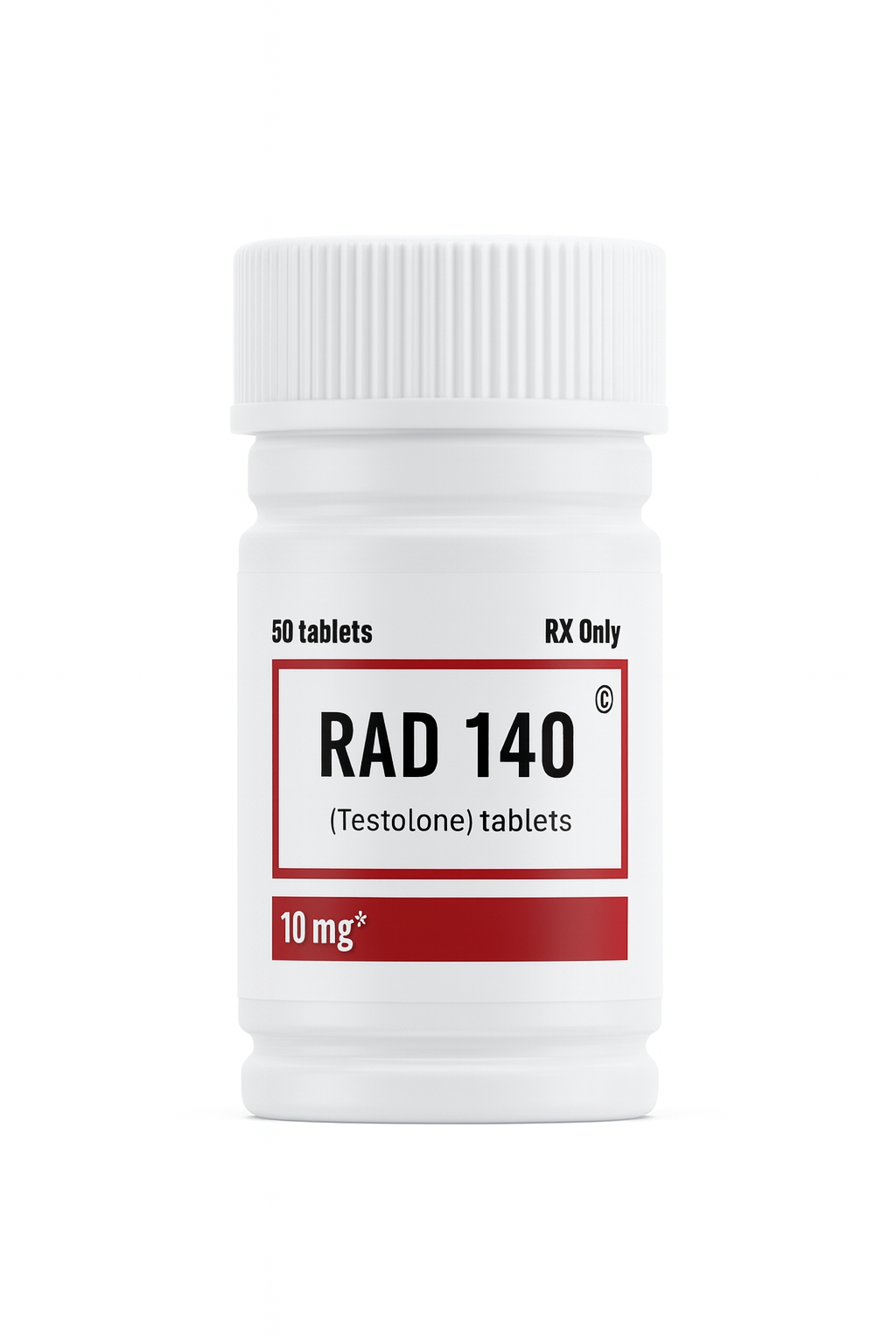
RAD-140 (Testolone) — Research Overview
RAD-140 (developmental code RAD140; trade name Testolone) is a non-steroidal selective androgen receptor modulator (SARM) developed by Radius Health. Preclinical research has shown it to be among the most anabolically potent SARMs identified to date, with a tissue selectivity ratio (anabolic:androgenic) exceeding 90:1 in some animal models — significantly higher than testosterone (~1:1) and early-generation SARMs.
Mechanism of Action
RAD-140 binds to the androgen receptor with high affinity and induces an AR conformational change that preferentially recruits anabolic coactivators in muscle and bone while failing to fully activate androgenic transcriptional programs in prostate and seminal vesicle tissue. The structural basis for this selectivity involves the positioning of helix 12 of the AR-LBD, which adopts different conformations depending on the bound ligand — a key focus of SARM structural pharmacology research.
RAD-140 also activates the MAPK signaling pathway independent of classical AR genomic signaling (non-genomic AR activity), contributing to rapid anabolic effects in skeletal muscle.
Research Applications
RAD-140 appears in multiple research domains:
- Muscle hypertrophy models: Potency studies — RAD-140 at lower masses produces anabolic effects comparable to testosterone in animal models due to high receptor affinity
- Neuroprotection research: Androgen receptors in the CNS — RAD-140 has demonstrated neuroprotective effects in Alzheimer’s disease models, including protection against amyloid-beta toxicity
- ER+ breast cancer research: RAD-140 antagonizes estradiol-induced ER+ growth via AR agonism in ERα+/AR+ cell lines — a clinically relevant research intersection
- HPG axis modulation: LH/FSH suppression dose-response characterization
- Prostate safety research: Comparative studies vs. testosterone on prostate weight and PSA — preclinical data suggests minimal prostate stimulation
- SARM mechanism studies: AR conformational biology and coactivator recruitment
Pharmacokinetic Profile
RAD-140 is orally bioavailable with good gastrointestinal absorption. In preclinical primate studies, half-life was approximately 60 hours — one of the longest among SARMs. High protein binding and wide tissue distribution contribute to its sustained receptor exposure. Phase I trials are ongoing; published primate PK data is available in the peer-reviewed literature (Miller et al., 2011).
Neuroprotection Research Highlight
A notable research application of RAD-140 is its neuroprotective activity. Jayaraman et al. (2014) demonstrated that RAD-140 activates MAPK signaling in neurons, protects against apoptosis from amyloid-β peptide exposure, and reduces kainate-induced brain injury in rodent models — with neuroprotective efficacy comparable to testosterone but without peripheral androgenic effects. This positions RAD-140 as a research tool in CNS androgen receptor biology beyond its anabolic applications.
Supplied For
Research and laboratory use by qualified investigators under appropriate regulatory and ethical frameworks. Not for human consumption. Certificate of Analysis available upon request.

Reviews
There are no reviews yet.