
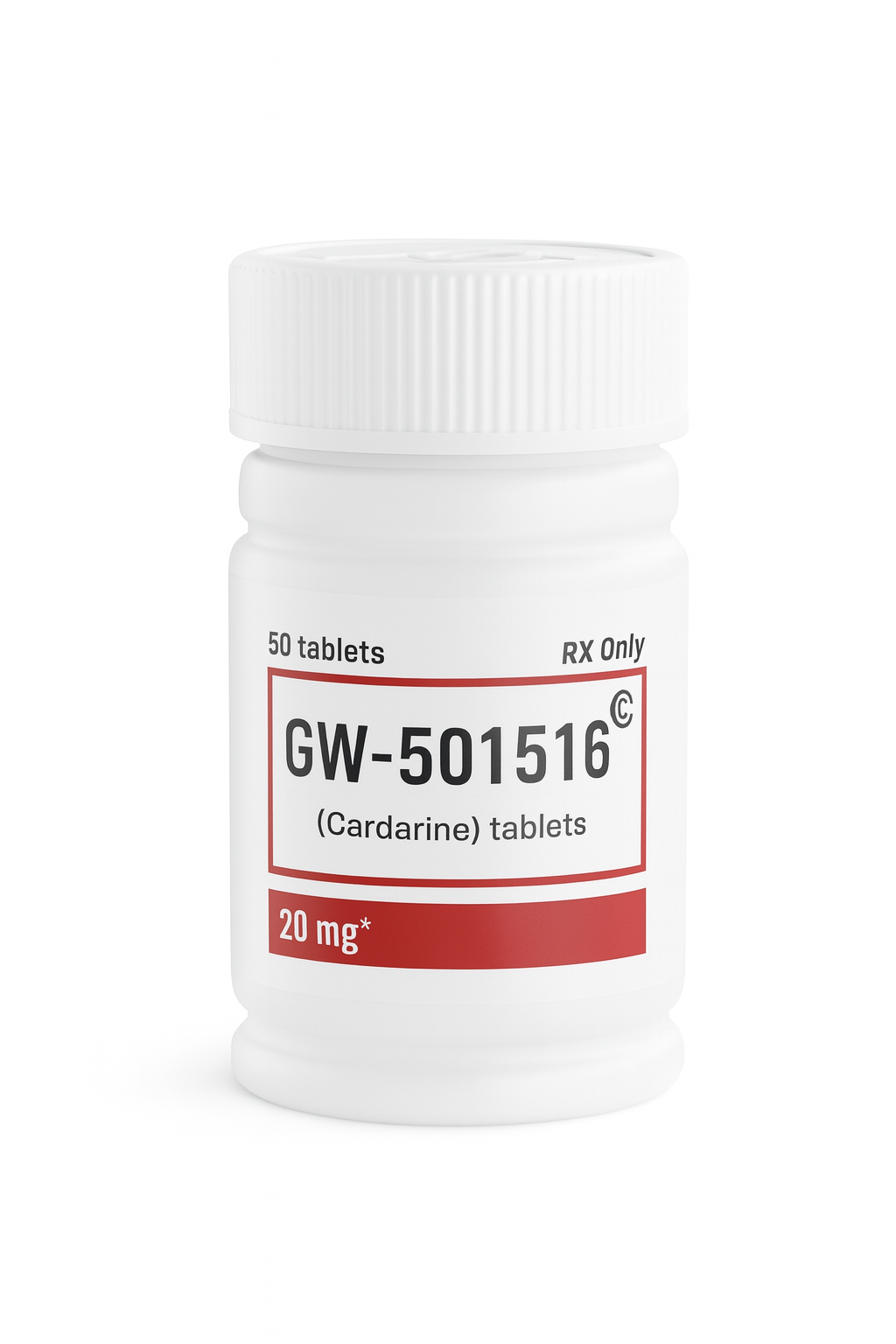
GW-501516, commonly called cardarine, is a selective PPAR-beta/delta agonist studied as a laboratory tool for nuclear-receptor signaling. The phrase “GW-501516 cardarine research” therefore describes work on receptor activity and downstream gene expression, not an established human application.
The evidence base is narrow and model-dependent. the cited studies comprise mouse studies and one cell model, with no human efficacy data; results in one model should not be generalized to another.
Research-use disclaimer: This article is educational material for qualified laboratory research only. GW-501516/cardarine is not presented as approved for human use, and this article provides no dosing, administration, treatment, or human-safety guidance.
What GW-501516 Is
GW-501516 is described in the the studies cited here as a selective PPAR-delta agonist, and the 2024 mouse study reports selectivity for this receptor. PPAR-delta is also called PPAR-beta/delta, so the source titles use both naming conventions. The cited studies investigate signaling, inflammation, muscle-receptor expression, stromal-cell conditioning, and tumor-immune interactions rather than a clinical indication.
How PPAR-delta Signaling Works in Research Models
Gene-Expression Effects
PPARs are transcription-regulating receptors, so GW-501516 research centers on ligand-activated signaling and changes in gene expression. In the cited studies, researchers reported inhibition of macrophage phagocytosis and tumor immune escape in mice, anti-inflammatory effects in an LPS and acute-liver-failure mouse model, increased insulin-receptor beta-subunit expression in rodent skeletal muscle, and MSC anti-apoptotic effects on chondrocytes through ANGPTL4 in a cell model.
In-Vitro Versus Animal-Model Boundaries
The 2026 report is a cell model, while the other cited reports use mice or rodent skeletal muscle. Mouse and cell findings can identify mechanisms or generate hypotheses, but they do not establish human efficacy or safety. Each reported result also depends on its experimental context, including the model, intervention, and measured endpoint.
2024-2026 Study Timeline
The following timeline is limited to the four studies cited here and summarizes reported results without treating them as clinical evidence.
| Study / Year | Model | Reported Result | Evidence Limit |
|---|---|---|---|
| PPAR-beta/delta priming enhances mesenchymal stromal cell anti-apoptotic properties on chondrocytes via ANGPTL4 (PMID 42556327) / 2026 | Cell model | Researchers reported that PPAR-beta/delta priming enhanced mesenchymal stromal-cell anti-apoptotic properties on chondrocytes through ANGPTL4. | In-vitro evidence; it does not establish an animal or human effect. |
| Selective PPAR-delta Agonist GW501516 Protects Against LPS-Induced Macrophage Inflammation and Acute Liver Failure in Mice (PMID 39519830) / 2024 | Mouse | The study reported selectivity and protection against LPS-induced macrophage inflammation and acute liver failure in mice. | Animal evidence; the result is tied to the reported mouse model and endpoints. |
| PPAR-beta/delta upregulates the insulin receptor beta subunit in skeletal muscle by reducing lysosomal activity and EphB4 levels (PMID 39696437) / 2024 | Rodent skeletal muscle | Researchers reported upregulation of the insulin-receptor beta subunit alongside reduced lysosomal activity and EphB4 levels. | Rodent tissue evidence; it does not establish a human metabolic outcome. |
| GW501516 facilitated tumor immune escape by inhibiting phagocytosis (PMID 39993702) / 2025 | Mouse | The study reported that GW501516 inhibited macrophage phagocytosis and facilitated tumor immune escape in mice. | Mouse tumor-immune evidence; it does not by itself define human risk. |
The Endurance-Selectivity Question and the Doping-Ban History
GW-501516 has been discussed in endurance research because PPAR-delta is a metabolic signaling target, but the studies cited here provide no human performance or efficacy data. Selectivity in the 2024 mouse study does not establish a human endurance effect. Historically, WADA prohibited GW-501516, and pharmaceutical development stopped after animal tumor signals. These are historical facts, not evidence that the compound is effective or safe for people.
What Is Not Yet Known
- Human efficacy: The studies cited here contain no human efficacy data, including no clinical evidence for endurance, metabolic, inflammatory, or tissue-repair outcomes.
- Cross-model translation: It remains unknown whether the mouse inflammatory, muscle, and tumor-immune findings or the cell-model ANGPTL4 result reproduce in other models or in people.
- Comparability: The studies measure different endpoints, so they do not establish a common benefit-risk profile or a direct comparison between models.
- Long-term and dose-related effects: the cited studies do not provide the information needed to define long-term effects, dose-response relationships, or human relevance.
- Mechanistic completeness: The reports identify selected pathways, but they do not establish every upstream or downstream mechanism responsible for the observed results.
GW-501516 Cardarine Research in 2026: Where the Field Stands
GW-501516 cardarine research in 2026 is best described as mechanistic and preclinical. The cited evidence shows that researchers continue to examine PPAR-beta/delta signaling in cells, rodents, inflammation, skeletal muscle, stromal-cell behavior, and tumor immunity. The same body of evidence also shows why evidence boundaries matter: a reported effect in one model is not a general conclusion about people. The defensible conclusion is that GW-501516 remains a research compound with model-specific findings, not a demonstrated human application.
What is GW-501516?
GW-501516, or cardarine, is described in the the studies cited here as a selective PPAR-delta agonist used in laboratory research. The cited work examines receptor signaling and experimental outcomes in cells or animals, not an approved human use.
Is cardarine the same as GW-501516?
Yes, cardarine is a common name for GW-501516 in the research literature. The name does not change the evidence limits described in the cited studies.
What receptor does GW-501516 target?
the cited studies describe GW-501516 as a selective PPAR-delta agonist, also called PPAR-beta/delta. The 2024 mouse study reports this selectivity.
What did the 2024 mouse inflammation study report?
The 2024 study reported protection against LPS-induced macrophage inflammation and acute liver failure in mice. This was an animal-model result, not human clinical evidence.
What did the 2024 skeletal-muscle study report?
The study reported that PPAR-beta/delta upregulated the insulin-receptor beta subunit in rodent skeletal muscle while reducing lysosomal activity and EphB4 levels. It does not establish a human metabolic effect.
What did the 2025 tumor-immunity study report?
The study reported that GW501516 inhibited macrophage phagocytosis and facilitated tumor immune escape in mice. That finding is specific to the reported mouse tumor-immune model.
What did the 2026 cell study report?
The 2026 cell study reported that PPAR-beta/delta priming enhanced mesenchymal stromal-cell anti-apoptotic properties on chondrocytes through ANGPTL4. Because it was a cell model, it does not establish an animal or human outcome.
Does GW-501516 improve endurance in humans?
the cited studies provide no human endurance or efficacy data. Any discussion of endurance relevance remains outside the evidence reported in these records.
Why is GW-501516 associated with a doping ban?
GW-501516 is associated with doping history because WADA prohibited it. WADA lists GW-501516 among prohibited substances, and the agency publishes the prohibited list; readers should consult the current WADA prohibited list for the operative rules.
Why did pharmaceutical development stop?
Development as a drug candidate stopped after animal tumor signals were reported during preclinical evaluation, which is why the compound never reached approved medical use. The detailed development record sits in company filings rather than in the four studies cited here.
Is GW-501516 approved for human use?
the cited studies do not present GW-501516 as an approved human medicine. This article provides no human-use, dosing, route, treatment, or safety guidance.
What remains unknown about GW-501516?
Unknowns include human efficacy, cross-model reproducibility, long-term effects, dose-response relationships, and the full mechanism behind the reported findings. These open questions cannot be answered from the studies cited here those questions.
View the GW-501516 research reference listing or read the SARMs research guide. Related reading: tesamorelin visceral-fat meta-analysis and the MK-677 research guide.