

Key Takeaways
- A 2026 systematic review and meta-analysis pooled five randomized, placebo-controlled tesamorelin trials conducted in adults living with HIV.
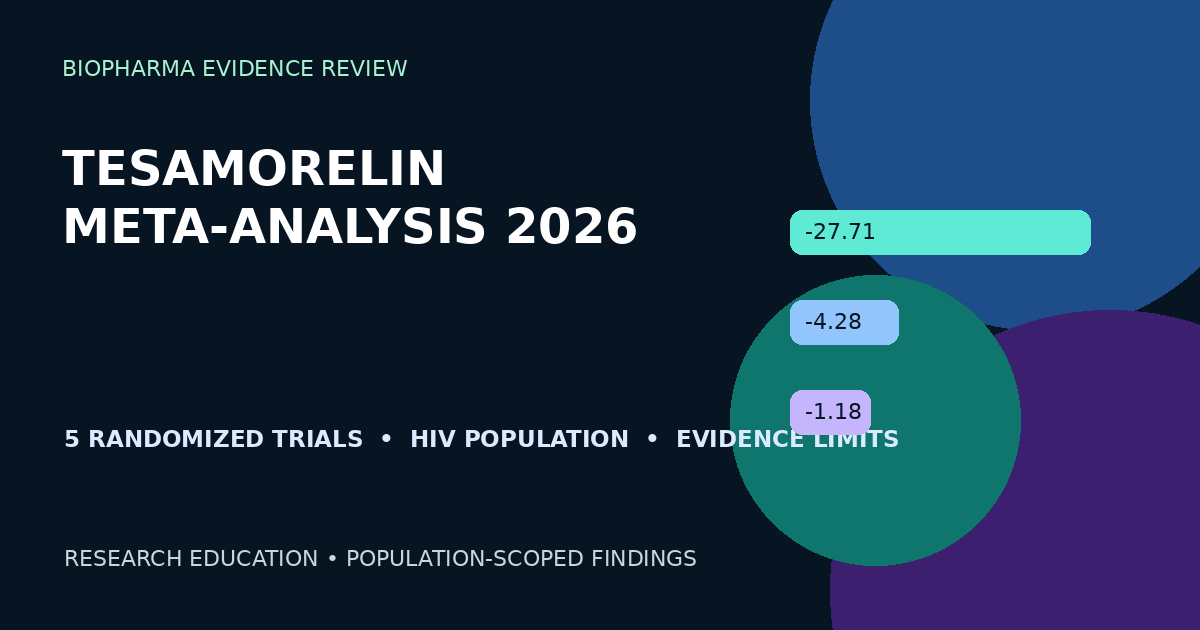
- The pooled mean difference in visceral adipose tissue was −27.71 cm² versus placebo (95% CI −38.37 to −17.06).
- The analysis also reported changes in trunk fat (−1.18 kg), hepatic fat percentage (−4.28 points), waist circumference (−1.61 cm), and lean body mass (+1.42 kg).
- No significant pooled reduction appeared for subcutaneous adipose tissue or BMI. These data are not evidence of general weight-loss effects.
- Every trial in this evidence set involved adults with HIV; the estimates should not be generalized to unrelated populations.
- Long-term cardiovascular outcomes, broad population effects, and durability remain unresolved.
The clearest answer from the 2026 evidence synthesis is narrow: across five placebo-controlled trials in adults with HIV, tesamorelin was associated with a pooled reduction in visceral adipose tissue and several related body-composition measures. The analysis does not establish a general-population fat-loss effect, and it does not answer long-term cardiovascular or clinical-outcome questions.
Research boundary: This article explains published evidence and regulatory context. It is not medical advice and provides no dosing, route, administration, treatment, efficacy, or safety guidance. BioPharma compounds are for research and laboratory use only and are not intended for human or veterinary use.
What Is Tesamorelin?
Tesamorelin is a synthetic analogue of human growth hormone-releasing hormone, commonly abbreviated GHRH. The studied molecule retains the GHRH(1–44) sequence with a modification intended to improve stability relative to the native peptide. In research, its downstream signals are commonly assessed through growth hormone and insulin-like growth factor 1, or IGF-1.
Identity and context matter. A catalog research material, an FDA-approved branded formulation, and the intervention used in a clinical trial are not automatically interchangeable. Formulation, quality controls, population, endpoints, and study oversight all affect what a result can support.
What Did the 2026 Meta-Analysis Ask?
The 2026 paper in Obesity Research & Clinical Practice searched five major literature databases through July 2025 for randomized controlled trials comparing tesamorelin with placebo in adults living with HIV. The investigators used random-effects meta-analysis and assessed risk of bias with RoB 2.0 and evidence certainty with GRADE.
The review included five RCTs. Its outcome map covered visceral and subcutaneous adipose tissue, trunk and limb fat, lean body mass, hepatic fat percentage, waist circumference, metabolic and hormonal markers, CD4-positive T-cell counts, and adverse events. That breadth is useful, but a pooled estimate remains dependent on the quality and comparability of its component trials.
Why the population boundary matters
The paper did not pool trials from a general weight-management population. Its inclusion criterion was adults with HIV, and the landmark trials focused on HIV-associated abdominal fat accumulation, lipodystrophy, or fatty liver disease. This population column is therefore essential when interpreting every number below.
Evidence Table: Population, Design, and Scope
| Source | Evidence level | Population | Main scope | Interpretive boundary |
|---|---|---|---|---|
| PMID 18057338, 2007 | Phase 3 randomized placebo-controlled trial; 412 participants | Adults with HIV and treatment-associated abdominal fat accumulation; 86% men | 26-week visceral-fat endpoint with metabolic secondary measures | HIV-associated central fat accumulation, not general weight loss |
| PMID 25038357, 2014 | Preliminary randomized placebo-controlled trial; 50 enrolled | Antiretroviral-treated adults with HIV and abdominal fat accumulation | Six-month visceral-fat and liver-fat endpoints | Small study; clinical importance and long-term consequences remained unknown |
| PMID 31611038, 2019 | Randomized, double-blind multicentre trial; 61 enrolled | Adults with HIV and at least 5% hepatic fat fraction | 12-month hepatic-fat endpoint and liver-histology context | HIV-associated fatty liver disease; longer-term liver effects required study |
| PMID 38905488, 2024 | Prespecified subgroup analysis from the 61-person trial | Adults with HIV on integrase-inhibitor regimens; 38 at baseline | Visceral fat, hepatic fat, fat distribution, and glycemic safety | Subgroup evidence; smaller completed-arm counts |
| PMID 41545261, 2026 | Systematic review and random-effects meta-analysis of five RCTs | Adults with HIV represented in the eligible trials | Pooled body composition, hepatic, metabolic, hormonal, and safety outcomes | Pooled HIV-population evidence; not proof for unrelated populations |
What Were the Pooled Body-Composition Findings?
The primary headline was a mean difference in visceral adipose tissue of −27.71 cm² compared with placebo, with a 95% confidence interval from −38.37 to −17.06 cm². The interval did not cross zero, and the reported P value was below 0.001.
Other pooled estimates included trunk fat at −1.18 kg, limb fat at −0.22 kg, waist circumference at −1.61 cm, and lean body mass at +1.42 kg. The authors found no significant pooled reductions in subcutaneous adipose tissue or BMI. Those null findings help prevent an important category error: changing a particular fat compartment is not the same as producing broad weight loss.
Visceral fat is not the same as subcutaneous fat
Visceral adipose tissue (VAT) sits inside the abdominal cavity around organs. Subcutaneous adipose tissue (SAT) lies beneath the skin. Trials can measure these compartments separately with imaging, and an effect in one should not be assumed in the other.
What Did the Research Show About Liver Fat?
The 2026 meta-analysis reported a pooled mean difference in hepatic fat percentage of −4.28 percentage points versus placebo (95% CI −6.31 to −2.24). That pooled estimate is consistent in direction with two important trials, but each study had its own design and population.
In the 2014 JAMA trial, 50 antiretroviral-treated adults with HIV and abdominal fat accumulation were enrolled. At six months, the net effect on liver lipid-to-water percentage was −2.9 points. The investigators called the study preliminary and stated that the clinical importance and long-term consequences required further research.
The 2019 Lancet HIV trial enrolled 61 people with HIV and fatty liver disease. At 12 months, the reported absolute effect on hepatic fat fraction was −4.1 percentage points (95% CI −7.6 to −0.7). The authors again emphasized the need to determine longer-term liver-histology effects.
How Should the Glucose Findings Be Read?
The meta-analysis authors concluded that tesamorelin changed the measured body-composition and hepatic outcomes without serious glucose perturbation overall. That summary should not be shortened to “no glucose effect.” In the 2014 trial, fasting glucose rose at two weeks relative to placebo, while the between-group changes at six months were not significant. The 2019 trial found no between-group difference in fasting glucose or glycated haemoglobin at 12 months.
This is a useful example of why time point, endpoint, and aggregation matter. A pooled conclusion can coexist with a temporary signal in an individual trial. Evidence-aware interpretation reports both rather than selecting only the more reassuring sentence.
What Did the INSTI-Era Subgroup Add?
Phase 3 development occurred before integrase strand transfer inhibitors, or INSTIs, became a dominant part of HIV therapy. A 2024 analysis therefore examined participants taking INSTI-based regimens within the later fatty-liver trial.
Among 38 participants on INSTI regimens at baseline, 15 in the tesamorelin arm and 16 in the placebo arm completed 12 months. The analysis reported median changes of −25 versus +14 cm² for visceral fat and −4.2% versus −0.5% for hepatic fat. Adverse-event frequency, including hyperglycemia, was similar between groups. Because this was a subgroup with modest completed counts, it is informative but not a replacement for a dedicated, larger trial.
Phase 2, Phase 3, and Meta-Analysis Are Different Evidence Layers
| Evidence layer | What it can add | What it does not guarantee |
|---|---|---|
| Preliminary or focused RCT | Tests defined imaging or metabolic endpoints under controlled conditions | Broad generalizability, durable outcomes, or definitive clinical importance |
| Phase 3 RCT | Provides a larger confirmatory comparison in a prespecified population | Applicability outside that population or proof of every long-term outcome |
| Subgroup analysis | Explores whether findings remain visible in a clinically relevant subset | The precision or protection from chance of a purpose-built larger trial |
| Meta-analysis | Combines compatible trial estimates and quantifies pooled uncertainty | Removal of bias, heterogeneity, endpoint differences, or population limits |
The strongest interpretation uses these layers together. The 2026 paper improves precision around several pooled endpoints; it does not transform HIV-specific trials into general-population evidence.
FDA Status and the Difference Between an Indication and a Research Question
Current FDA labeling lists EGRIFTA SV and EGRIFTA WR for reducing excess abdominal fat in HIV-infected adults with lipodystrophy. The same label says the products are not indicated for weight-loss management, notes a weight-neutral effect, and states that long-term cardiovascular safety has not been established.
An approved indication is a specific regulatory conclusion for specific branded products and a defined population. It does not apply automatically to other materials, formulations, populations, or objectives. BioPharma’s catalog material is separate from the FDA-approved products discussed in the label.
What Is Not Yet Known?
- Long-term cardiovascular outcomes: the FDA label states that long-term cardiovascular safety has not been established.
- General-population effects: the pooled trial population was adults living with HIV, not a general weight-management sample.
- Durability: prior extension evidence indicates that visceral-fat changes may reverse after discontinuation, but durability can vary by design and follow-up.
- Hard clinical outcomes: imaging and body-composition changes do not by themselves prove fewer cardiovascular, hepatic, or mortality events.
- Subgroup precision: INSTI-era data are useful but derive from a smaller subgroup analysis.
- Material equivalence: findings for regulated trial formulations cannot be transferred automatically to a catalog research material.
Key Terms and Definitions
- GHRH
- Growth hormone-releasing hormone, a hypothalamic signaling peptide that stimulates growth-hormone release.
- IGF-1
- Insulin-like growth factor 1, a downstream marker and mediator in the growth-hormone axis.
- VAT
- Visceral adipose tissue located within the abdominal cavity.
- SAT
- Subcutaneous adipose tissue located beneath the skin.
- Hepatic fat fraction
- The proportion of measured liver signal attributed to fat, commonly estimated with magnetic-resonance methods in these trials.
- INSTI
- Integrase strand transfer inhibitor, a class of antiretroviral medicines.
- Mean difference
- The average between-group difference in change for a measured outcome.
- 95% confidence interval
- A range expressing statistical uncertainty around an estimate under the analysis model.
Frequently Asked Questions About Tesamorelin Research
What is tesamorelin?
Tesamorelin is a synthetic analogue of the 44-amino-acid human growth hormone-releasing hormone sequence. It has been studied through the growth-hormone and IGF-1 axis, especially in adults with HIV-associated lipodystrophy.
What did the 2026 tesamorelin meta-analysis examine?
It pooled five randomized, placebo-controlled trials in adults with HIV and evaluated body composition, hepatic fat, metabolic markers, hormonal markers, and adverse events.
How much did visceral adipose tissue change in the pooled analysis?
The meta-analysis reported a mean difference of minus 27.71 square centimetres versus placebo, with a 95% confidence interval from minus 38.37 to minus 17.06 square centimetres.
Did the meta-analysis find a change in liver fat?
Yes. The pooled estimate for hepatic fat percentage was minus 4.28 percentage points versus placebo, with a 95% confidence interval from minus 6.31 to minus 2.24.
Did tesamorelin reduce body weight or BMI in the analysis?
The meta-analysis did not find a significant BMI reduction. The FDA label also states that approved tesamorelin products are not indicated for weight-loss management and describes them as weight neutral.
What happened to lean body mass?
Across the included trials, the pooled mean difference in lean body mass was plus 1.42 kilograms, with a 95% confidence interval from 1.13 to 1.71 kilograms.
Did the pooled analysis show a serious glucose disturbance?
Its authors concluded that glucose was not seriously perturbed overall. Individual studies still reported time-specific glucose observations, so the pooled conclusion should not be treated as proof of zero glycemic risk.
Were the findings from the general population?
No. Every trial represented in the evidence table involved adults living with HIV, usually with abdominal fat accumulation, lipodystrophy, or HIV-associated fatty liver disease.
Is tesamorelin FDA approved?
FDA labeling lists EGRIFTA SV and EGRIFTA WR for reducing excess abdominal fat in HIV-infected adults with lipodystrophy. The label explicitly says the products are not indicated for weight-loss management.
What does visceral adipose tissue mean?
Visceral adipose tissue, or VAT, is fat located within the abdominal cavity around internal organs. It is distinct from subcutaneous fat beneath the skin.
What remains unknown after the meta-analysis?
Key gaps include long-term cardiovascular outcomes, broader general-population effects, durability after discontinuation, and how well pooled averages predict responses in specific subgroups.
Does this article provide human-use instructions?
No. It is research education only and provides no dosing, route, administration, treatment, efficacy, or safety instructions. BioPharma materials are not intended for human or veterinary use.
Sources
- 2026 systematic review and meta-analysis of five randomized trials. Obesity Research & Clinical Practice. PMID 41545261.
- Metabolic effects of a growth hormone-releasing factor in patients with HIV. New England Journal of Medicine. 2007. PMID 18057338.
- Effect of tesamorelin on visceral fat and liver fat in HIV-infected patients. JAMA. 2014. PMID 25038357.
- Effects of tesamorelin on fatty liver disease in HIV. The Lancet HIV. 2019. PMID 31611038.
- Efficacy and safety of tesamorelin in people with HIV on integrase inhibitors. AIDS. 2024. PMID 38905488.
- FDA drug-label records for tesamorelin. Current indication and use-boundary source.
Related BioPharma Research
For adjacent evidence reviews, see the AOD9604 research guide and the DSIP evidence guide. These are different research materials and their findings should not be transferred to tesamorelin.
Qualified laboratories can review BioPharma Tesamorelin 10mg research material or browse the research peptides category. Catalog availability does not imply a clinical indication, protocol, expected outcome, or equivalence to any branded formulation used in published trials.
Research disclaimer: For research and laboratory use only. Not intended for human or veterinary use. This article does not constitute medical advice. BioPharma does not provide dosing, route, administration, treatment, efficacy, or safety guidance.